Transformers from Scratch
The Transformer is the encoder you'll propose for any sequence: words, user click histories (Sequence Recommenders - DIN, SASRec, BERT4Rec), account event streams (AM-05 The Sia…
The Transformer is the encoder you’ll propose for any sequence: words, user click histories (Sequence Recommenders - DIN, SASRec, BERT4Rec), account event streams (AM-05 The Siamese Behavioral Encoder), agent trajectories (Motion Prediction - VectorNet and Beyond), image patches (Vision Transformers). You must be able to explain attention with actual numbers.
1. The problem with previous sequence models
RNNs/LSTMs process tokens one at a time, passing a hidden state forward. Two killers: (a) sequential = no parallelism — training can’t use the GPU’s width; (b) long-range information decays — a signal from token 3 must survive 500 recurrent updates to influence token 503 (gates help; they don’t cure). The Transformer replaces recurrence with attention: every token directly looks at every other token, in parallel, one hop.
2. Attention, with numbers
Each token’s current vector $x_i$ is linearly projected into three roles:
- Query $q_i = W_Q x_i$ — “what am I looking for?”
- Key $k_i = W_K x_i$ — “what do I contain (for others searching)?”
- Value $v_i = W_V x_i$ — “what do I give if you attend to me?”
Token $i$ scores every token $j$ by $q_i \cdot k_j$, softmaxes the scores into weights, and outputs a weighted average of values:
\[\text{Attention}(Q,K,V) = \text{softmax}\!\left(\frac{QK^\top}{\sqrt{d_k}}\right)V\]Tiny worked example ($d_k = 2$, 3 tokens, suppose after projection):
- $q_2 = (1, 0)$; keys: $k_1 = (1,0),\, k_2=(0,1),\, k_3=(0.9,0.1)$; values: $v_1=(1,1),\, v_2=(0,5),\, v_3=(2,0)$.
- Raw scores $q_2\cdot k_j$ = (1.0, 0.0, 0.9); divide by $\sqrt{2}$ → (0.71, 0, 0.64).
- Softmax → weights ≈ (0.41, 0.20, 0.39).
- Output for token 2 = $0.41(1,1) + 0.20(0,5) + 0.39(2,0) = (1.19, 1.41)$.
Token 2’s new representation is mostly built from tokens 1 and 3 — the ones whose keys matched its query. All of this is dynamic: the same word attends to different context in different sentences.
Why divide by $\sqrt{d_k}$: dot products of random $d_k$-dim vectors have variance $\propto d_k$; without scaling, large logits saturate the softmax (near one-hot) → vanishing gradients.
3. Multi-head attention
Run $h$ attention modules in parallel with separate $W_Q, W_K, W_V$ (each of dimension $d/h$), concatenate outputs, project. Each head can specialize: one tracks syntax-like relations, another co-reference, another positional locality. Cheap (same total FLOPs as one big head) and consistently better.
4. The rest of the block
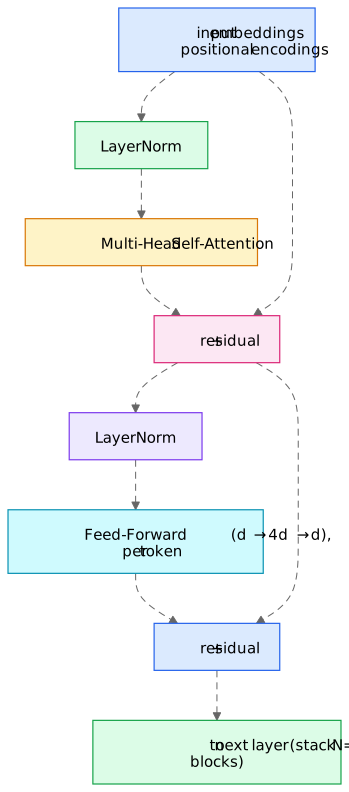
- Residual connections ($x + \text{sublayer}(x)$): gradients flow through the identity path → deep stacks train. Same idea as ResNet.
- LayerNorm: normalizes each token’s vector to stable scale (modern stacks put it before the sublayer — “pre-LN” — for stability).
- FFN: a 2-layer MLP applied identically to every token; attention moves information between tokens, the FFN processes it. Most parameters live here.
- Positional encodings: attention is permutation-invariant — without position info, “dog bites man” = “man bites dog.” Solutions: learned position embeddings (BERT), sinusoidal (original), or RoPE (rotary; rotates q,k by position-dependent angles; standard in modern LLMs and extrapolates better). For event sequences (account histories), encode time deltas between events, not just index — emphasize this in the Roblox design.
5. Three architectural flavors
| Flavor | Attention mask | Pretraining | Use |
|---|---|---|---|
| Encoder (BERT) | bidirectional — every token sees all | masked-token prediction | understanding/classification/embeddings |
| Decoder (GPT) | causal — token $i$ sees only $\le i$ | next-token prediction | generation; also next-item recsys (SASRec) |
| Encoder–decoder (T5) | enc bidirectional, dec causal + cross-attention into encoder | span corruption | translation, summarization |
“Causal mask” = set future positions’ attention logits to $-\infty$ before softmax.
6. Complexity and the long-sequence problem
Self-attention computes a $T \times T$ score matrix: O(T²·d) time, O(T²) memory. T = 512 is cheap; T = 100k (lifelong user histories, long docs) is not. Mitigations interviewers like:
- Truncate/summarize history; hierarchical encoders (encode sessions → encode session-embeddings).
- Sparse/local attention (Longformer), linear attention (Performer).
- FlashAttention: exact attention computed tile-by-tile in GPU SRAM — memory O(T), large constant-factor speedups; standard in all modern training.
- At inference, decoding caches K/V of past tokens — the KV cache — making each new token O(T) instead of O(T²); the KV cache’s memory footprint drives LLM Serving Internals.
7. What to say in an interview when you propose a Transformer
“I’d encode the event sequence with a small Transformer encoder — 2–4 layers, d=128, with time-delta-aware positional encodings; sequences truncated/pooled to the last N=512 events; mean-pool or [CLS]-pool to a single vector.” Sizing it concretely (and small!) signals production sense: encoder towers in recsys/abuse systems are 10⁶–10⁷ params, not GPT-scale.