Anatomy of a Fraud Detection System
The generic trust-&-safety architecture. Account matching is a specialization of this; payment fraud, spam, bot detection are siblings.
The generic trust-&-safety architecture. Account matching is a specialization of this; payment fraud, spam, bot detection are siblings.
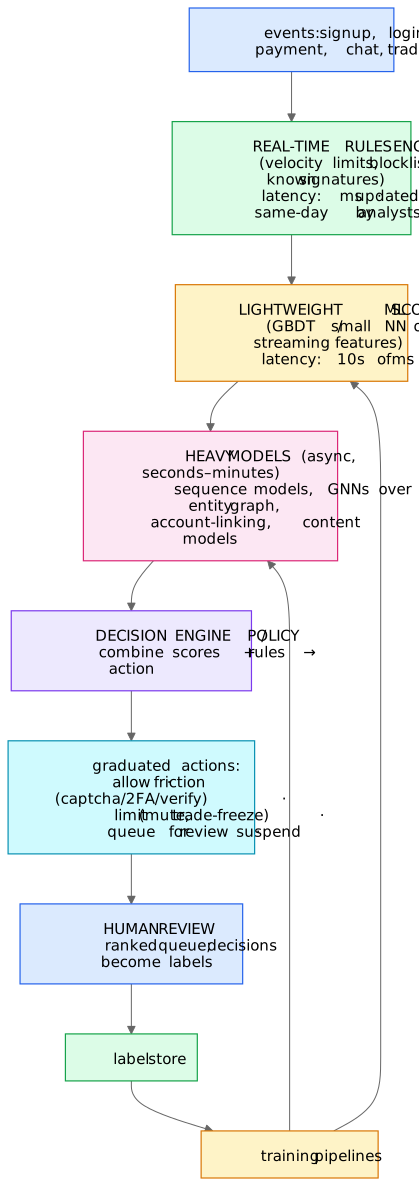
Why three layers of detection (say this)
- Rules = speed of response. A new attack appears at 9am; an analyst ships a rule by noon; the model retrains next week. Rules are the immune system’s fast response; ML is the learned response. Never propose pure-ML for adversarial domains.
- Light ML = broad, cheap coverage on every event (synchronous, can block in-line).
- Heavy ML = expensive context (graphs, sequences, cross-account linking) computed asynchronously; results feed back as features/flags.
Design pillars
- Graduated enforcement + friction. Most decisions shouldn’t be ban/allow. Friction (captcha, phone verification, limits) is cheap when wrong and expensive for attackers at scale — the asymmetry you exploit. Severity × confidence matrix decides the action.
- Human review as a first-class component. Queue ranked by expected harm × model uncertainty; reviewer throughput is THE capacity constraint — thresholds derive from it; review decisions are your gold labels (and appeal reversals are gold false-positive labels). Measure reviewer agreement; route disagreements to senior review.
- Labels are weird here: delayed (chargebacks: 30–90 days), PU-contaminated, feedback-biased (you only labeled where you looked) → Class Imbalance, Calibration, and PU Learning + random-audit slices.
- Features: entity-level velocity counters (signups per device per hour; logins per IP per day) computed on streams with decay; reputation scores per entity (device/IP/email-domain); graph features; content features. Point-in-time discipline → Feature Stores and Point-in-Time Correctness.
- Adversarial cycle: attackers probe → adapt. Defenses: defense-in-depth across independent signal families, fast retrain cadence, don’t leak which signal fired (generic enforcement messages), canary/honeypot accounts, red-team exercises, and monitoring for sudden precision/score-distribution shifts (Monitoring, Drift, and Feedback Loops).
- Metrics: prevalence of harm (ideally from random audits — the unbiased estimator), precision of enforcement (appeal overturn rate as proxy), recall proxies (re-offense rate, time-to-detection), reviewer load, false-positive friction on good users.
Bot detection mini-pattern (common follow-up)
Signals: input telemetry (mouse/touch entropy — bots too regular), event-timing distributions, headless-browser fingerprints, per-entity velocity. Models: sequence perplexity (Anomaly Detection Methods) + supervised GBDT; clusters of synchronized accounts via the identity graph (AM-07 GNN over the Identity Graph). Always answer bot questions with population-level signals (synchronization across accounts), not just per-account.