Two-Tower Retrieval Networks (Dual Encoders)
The workhorse of Stage-1 retrieval everywhere (and the template for account-matching candidate generation).
The workhorse of Stage-1 retrieval everywhere (and the template for account-matching candidate generation).
Architecture
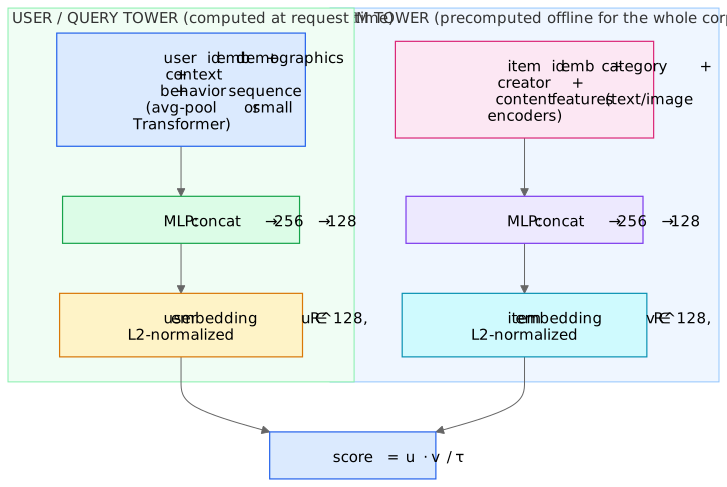
The defining constraint: the two towers never interact until the final dot product. That single restriction is what makes serving scalable:
- Offline: run the item tower over all N items → embed → build an ANN index.
- Online: run the user tower once (~1 ms), do one ANN query (~5 ms) → top-K from 10⁸ items.
Training
- Data: (user, engaged-item) pairs from logs. Choose the engagement that matches the product goal (click vs long-play vs purchase).
- Loss: in-batch sampled softmax with logQ correction — this exact combination is the standard answer. Add some uniform negatives (“mixed negative sampling”) so tail items are represented, and consider mined hard negatives in later training rounds.
- Temperature: cosine similarities with τ ≈ 0.05–0.2.
- ID dropout: randomly drop the item-ID embedding during training so content features carry weight → new items without trained IDs still embed sensibly (Cold Start and Exploration).
Why a dot product? (The interview “why” question)
Because ANN indexes can only search inner-product / cosine / L2 spaces efficiently. If the final scorer were an MLP over (u, v) you couldn’t index it — you’d be back to scoring all N items. The dot product is a deliberate expressiveness sacrifice purchased for serving speed; the lost expressiveness (feature crosses, e.g. “this user likes horror BUT only on weekends AND this is a weekend”) is reclaimed downstream by the heavy ranker (Feature Interaction Models - Wide&Deep, DeepFM, DCN, DLRM) and by cross-encoders in search.
Variations worth knowing
- Multi-interest retrieval: one embedding can’t represent a user who likes both anime and woodworking — the single vector lands in the useless middle. Fixes: K user embeddings via capsule routing (MIND) or multi-head attention (ComiRec); query ANN K times and merge.
- Two-tower for users-to-users: PYMK at LinkedIn, “find similar accounts” in abuse — both towers are user towers, sometimes the same tower (a Siamese setup).
- Content-only towers for cold-start corpora (news!) where item IDs churn daily.
- Freshness: user tower input includes real-time behavior (last 10 minutes) → user embedding recomputed per request; item embeddings refreshed on content change + index rebuilt incrementally.
Evaluation
- Offline: recall@K (is the held-out engaged item in the top K retrieved?) on a time-split eval; coverage/diversity of retrieved sets.
- Online: A/B the retrieval source’s marginal contribution (how many shown/engaged items came uniquely from it).
Common pitfalls (say these unprompted)
- Popularity bias from in-batch negatives → logQ correction (and check: does retrieval over-suppress head items?).
- Train/serve skew: feature pipelines differ online vs offline → Feature Stores and Point-in-Time Correctness.
- Embedding staleness/version skew: index built by encoder v3 queried with v4 user embeddings — always version and atomically swap.
- Feedback loop: the tower trains on engagements its own retrieval enabled → keep exploration traffic.