Feature Interaction Models — Wide&Deep, DeepFM, DCN, DLRM
These are the heavy rankers: models that score a few hundred candidates with rich features. Their shared obsession: feature crosses.
These are the heavy rankers: models that score a few hundred candidates with rich features. Their shared obsession: feature crosses.
Why crosses matter — a concrete example
Predicting pInstall for a game ad. Features: user_age_group, game_genre. Individually weak; jointly decisive: age=8-12 AND genre=pet-sim → very high; age=25-34 AND genre=pet-sim → low. A linear model over one-hot features literally cannot represent this (it can only add per-feature terms); it needs the conjunction age × genre as its own feature. With 100 categorical features of high cardinality, enumerating all pairs (let alone triples) explodes — hence a decade of architectures for learning crosses automatically. (A plain MLP over concatenated embeddings can approximate crosses but is empirically inefficient at it — multiplicative interactions are hard for additive layers to discover. That’s the one-line justification for all of the below.)
Wide & Deep (Google, 2016)
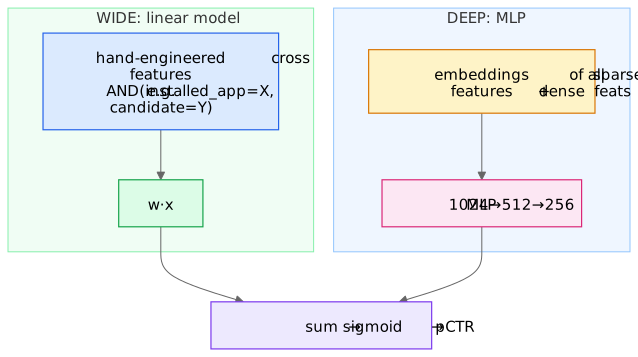
- Wide = memorization: the linear part with manual crosses can memorize exact exceptions (“users who installed X never install Y”) with one weight.
- Deep = generalization: embeddings let unseen combinations get sensible scores.
- Jointly trained. Historical importance: established the paradigm; weakness: the wide part needs manual feature engineering.
DeepFM (2017)
Replace the wide part with a Factorization Machine (FM). An FM scores every feature pair via the dot product of their embeddings:
\[\hat y = w_0 + \sum_i w_i x_i + \sum_{i<j} \langle e_i, e_j\rangle\, x_i x_j\]Key insight: pairwise weights are factorized — the cross weight for (age=8-12, genre=pet-sim) is ⟨e_age, e_genre⟩, so it can be estimated even if that exact pair is rare (each embedding learns from all its other co-occurrences). DeepFM = FM (automatic 2nd-order crosses) + MLP (higher-order, implicit), sharing the same embeddings, no manual crosses.
DCN / DCN-v2 (Deep & Cross Network)
Learns explicit bounded-degree polynomial crosses with cross layers. With $x_0$ = the stacked input embeddings, layer $l$:
\[x_{l+1} = x_0 \odot (W_l x_l + b_l) + x_l\]The elementwise product with $x_0$ raises the polynomial degree by one each layer — L cross layers ⇒ all crosses up to degree L+1, with O(d) parameters per layer instead of O(d²) enumerations. v2 uses low-rank $W = UV^\top$ and a mixture-of-experts of low-rank crosses for efficiency. DCN-v2 + parallel MLP is approximately Google’s default ads/recs ranker — say “DCN-v2” in Google interviews.
DLRM (Meta, 2019) — the systems-flavored one
Architecture: dense features → bottom MLP → a vector; each sparse feature → embedding; interaction = all pairwise dot products among these vectors (FM-style), concatenated with the dense vector → top MLP → pCTR.
Why it’s famous is systems, not math: production DLRMs have terabyte-scale embedding tables (billions of IDs × hundreds of features). Training is hybrid-parallel: embedding tables sharded across GPUs (model parallel — each GPU owns some tables), MLPs replicated (data parallel), with an all-to-all exchange of looked-up embeddings each step. Inference needs caching tiers (HBM ↔ DRAM ↔ SSD) for hot/warm/cold rows, plus the hashing trick. If your interviewer says “embedding table doesn’t fit,” this is the answer sheet. See Distributed Training.
Honorable mentions (one-liners you can drop)
- xDeepFM (CIN): vector-wise explicit high-order crosses; expensive.
- AutoInt: self-attention over feature embeddings as the interaction layer — “let attention pick which features to cross.”
- GBDTs (XGBoost/LightGBM): still extremely strong on pure-tabular ranking; the right baseline to name before proposing deep models — trees natively learn axis-aligned crosses.
Choosing in an interview
| Situation | Pick |
|---|---|
| Default modern heavy ranker | DCN-v2 (+ multi-task heads → Multi-Task Learning - Shared Bottom, MMoE, PLE) |
| Want zero manual features, mid-scale | DeepFM |
| Asked about Meta-scale infra | DLRM + sharding story |
| Strong baseline / limited data / interpretability | GBDT |
All of them sit at Stage 2 of The Two-Stage RecSys Funnel and consume features governed by Feature Stores and Point-in-Time Correctness.