The Two-Stage (really Multi-Stage) RecSys Funnel
Every industrial recommender — LinkedIn feed, YouTube, Roblox discovery, ads — has the same skeleton, because of one arithmetic fact: you cannot run an expensive model on 10⁸ it…
Every industrial recommender — LinkedIn feed, YouTube, Roblox discovery, ads — has the same skeleton, because of one arithmetic fact: you cannot run an expensive model on 10⁸ items per request. You buy precision with compute progressively.
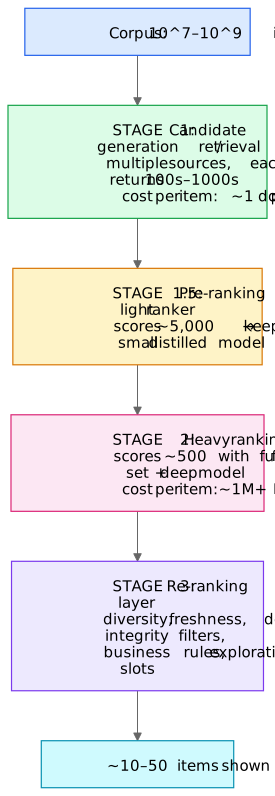
Stage 1 — Candidate generation
Multiple parallel sources, union-ed (never a single retriever):
- Two-tower model + ANN (the learned, personalized source — Two-Tower Retrieval Networks).
- Item-to-item / covisitation: “users who played X also played Y” from co-occurrence counts; cheap, robust, great for related-item surfaces.
- Social/graph: items your connections engaged with (LinkedIn’s bread and butter).
- Heuristics: trending, new-from-followed-creators, geographic, editorial.
- Exploration source: fresh/boosted items for Cold Start and Exploration.
Per-source quotas and dedup; retrieval is evaluated by recall@K against later-stage positives (“did the items the user actually engaged with survive retrieval?”).
Why multiple sources: each has a different inductive bias and failure mode; union is robust; it also decouples teams. Mention “the funnel can only lose good items — retrieval recall upper-bounds the whole system.”
Stage 1.5 — Pre-ranking
A model cheap enough for thousands of items but smarter than a dot product: usually a small MLP or a distilled version of the heavy ranker (Model Compression - Distillation and Quantization), often two-tower-with-late-MLP (“two-tower plus light interaction”). Goal: maximize agreement with the heavy ranker’s top-K at 1% of its cost.
Stage 2 — Heavy ranking
Full feature set: user profile + behavior sequence, item features, context (time, device, surface), cross features, and real-time counters. Architectures: Feature Interaction Models - Wide&Deep, DeepFM, DCN, DLRM; sequence modules: Sequence Recommenders - DIN, SASRec, BERT4Rec; multi-objective heads: Multi-Task Learning - Shared Bottom, MMoE, PLE. Latency budget for this stage: ~10–30 ms for ~500 items → batched GPU inference, feature-fetch is usually the bottleneck (hence feature stores with online caches).
Stage 3 — Re-ranking & policy
Where modeling meets product:
- Diversity: don’t show 10 near-identical items — MMR (maximal marginal relevance: score minus similarity to already-picked items) or determinantal point processes (DPP); or a small sequence model that picks the slate jointly.
- Integrity/safety filters: age-appropriateness (huge for Roblox), policy filters — these are hard constraints, applied after ranking so they can’t be traded against engagement.
- Business rules: ads load, freshness quotas, creator fairness, dedup vs recently shown (impression discounting).
- Exploration slots for cold-start items.
Metrics at each stage (know this table)
| Stage | Offline metric | Online metric |
|---|---|---|
| Retrieval | recall@K, coverage | downstream engagement of its candidates |
| Ranking | AUC / logloss per head, NDCG | CTR, dwell, session success |
| Whole system | — | north-star: DAU/sessions/retention; guardrails: reports, hides, latency |
Interview moves
- Always draw this funnel first; it structures the rest of your answer.
- State latency math: “100ms budget = 20ms retrieval + 10ms prerank + 30ms rank + 20ms feature fetch + slack.”
- Mention train/serve consistency: the ranker trains on logged impressions, which were chosen by yesterday’s system → feedback loops (Monitoring, Drift, and Feedback Loops) and position bias (Position Bias and Counterfactual Learning).